So this prompt could be either an interesting will, someone determined to do something, or a Will in the family. Well we have lots of Williams on the Golden side! So lets start with the first one! Did you think it was Grandpa Great? Nope, try 10th Great Grandpa Golden :O Also look at all these William's and Joseph's. Poor Andrew, lol, sticking out like a sore thumb.
Are you tired of scrolling down? Here is some information on William Golden.
The original surname may not have been Golden and may have been Goulder or Golding.
These are all the notes I have gathered on him through various sources:
According to William H. Stillwell's "History of Gravesned" p. 37 William Goulding was born in Ireland about 1613, embarked from London, August 2, 1635, in the George for Virginia and was probably one of George Holmes' party which tried to put a settlement on the Delaware; was captured by the Dutch and brought to New Amstedam. Campion says a William Golding was a taxpayer in Barbadoes and may ahve been the same person later in Gravesend. Salter in his History of Monmouth and Ocean Counties says it is supposed that William Golding was one of Lady Deborah Moody's friends who left Massachusetts on a count of Puritan persecution. Be that as it may, William Goulder or Golding, it seems likely first settled in New Amsterdam sometime prior to his marriage in 1644, as in 1643 he signed a certificate of election.
By deed dated March 20, 1649 (book 1, page 31) William Goulder bought land in Gravesend and presumably moved there about that time from New Amsterdam. For several years, starting ca. 1666 he was town clerk, signing as "Will Goulding - clarke." On May 5, 1652 Ann Goulder, wife of William Goulder was defendant in an action of defamation. She was found guilty and warned. The warning apparently was not heeded for on Sept 13, 1652 she was again accused. This time the Court ordred that "Ann shall sitt in ye Irons halfe one hower and after bee taken out and stand in a publicke place with a pap one her breast w her hands bound behinde her..." (ibid. pp. 133,134)
Two deeds, one dated, Jany 12, 1660, and the other Feb 13, 1660 (Book II, pp. 59, 62), for land in Gravesend were signed by Will Goulder alias Goulding. On March 20, 1665 John Smithe of Gravesend coveyed land known as No. 35 to his father-in-law William Goulder alias Goulding (Ibid. pp 87, 88) and Will Goulding reconveyed his land March 21, 1666/67 (Ibid p. 91) On June 15, 1669, Will Goulding, Clarke, attested to a conveyance which had been witnessed by Joseph Goulding, his marke (ibid, p. 101). This witness was probably the young son about 15 years of age.
William Goulding was one of the twelve men to whom the Monmouth patent was granted in 1665. In the original division of town lots in Middletown, 1667, he was given Lot 25, and also outlands. He sold his town lot and meadows to Richard Hartshorne, the deed for which is dated April 23, 1670, and recorded Nov 25, 1672. In the records of Freehold, NJ, his name is given as Will Golding. It is not clear when William Goulder died, there being confusion in the records between William, Sr., and William, Jr., but it seems likely that the death occuredn ot too long after 1672.
---
Dutch manuscripts, 1630-64
Maybe about this William Goulder (Golden):
May 3, 1646
Court proceedings. William Goulder vs. Thomas Gridy; defendant to pay 20 guilders, for having suffered three defaults
September 15, 1646
Deed. Govert Lookermans and Direk Cornelissen agents to William Goulder, of a parcel of land at the east river on Manhattans island
February 7, 1647
Huyck Aertsen vs. William Goulder for purchase of a house and plantation, with corn; ordered that plaintiff prove the sale of the house and corn, and that Goulder's wife received the corn; also that he had asked her, when she lost her husband, Smith, whether she held to the bargain, which she took amiss.
April 1, 1653
Deed. William Goulder, attorney of Robert Pennoyer, to Arent van Hattem, bargonmaster; piece of land in Gravesend, L.I. (not executed)
-------------
In regards to deed above ^ on September 15, 1646
New Amsterdam and its people: studies, social and topographical, of the town ... By John H. Innes
At some time prior to the year 1646 Loockermans associate Cornelis Leendertsen died and Dirck Cornelissen who seems to have been his son had taken his place other partners in the Netherlands are spoken of in some papers executed by Loockermans and Dirck Cornelissen about this time but this may refer merely to others of Cornelis Leendertsen's heirs It was at this period that Govert Loockermans and Dirck Cornelissen after reserving the farmhouse and a parcel of ground of irregular shape lying to the east of it and embracing three acres or more of land disposed of the rest of the farm in the following manner The land lying between the farmhouse and Allerton's warehouse then probably just in course of erection was sold to one William Goulder This parcel which covered nearly two acres of ground ran from the height next the Strand back to Bestevaers Kreupelbosch and its easterly line seems to have about crossed the site of the present Harper building near Franklin Square along its foot on the Strand no longer following the present Pearl Street ran the road to Loockermans farmhouse and to the ferry
....f Loockermans and Cornelissen had any expectations that the neighborhood of their East River farm was to be improved by the grants they made to William Goulder and to George Cleer in 1646 they were doomed to disappointment Neither of these men seems to have made any attempt to build upon the lands purchased by them There are traces of Goulder's occupation of his parcel as late as 1649 after which no further reference to him is met with.
(footnote: He may have been the person called William Goulding, whom we find 1661 in Gravesend, L.I.)
----------------------
Treatise upon the estate and rights of the corporation of the city of New York, as proprietors
, Volume 2
April 10, 1647: Phillip De Truyn to Isaac Ollerton. Transport, out of the withinmentioned land, unto Isaac Ollerton, a certain parcel thereof, stretching north from the strand to the highway, being in breadth 1 rod and 1/17th and in length, along the waid way to the lot of William Goulder, 46 rods, and so back again from the way to the strand.
------------------
The Journal of the Friends' Historical Society, Volumes 9-10 By Friends' Historical Society, Norman Penney
Regarding William Goulder selling his land to Hasthorne (see above)
Richard Hartshorne was a considerable setler who at Middletown in 1669 It was not until the year of GF s that the governor and council of East New Jersey were to purchase all lands from the Indians and to reimburse themselves from the settlers Meanwhile Richard Hartshorne met with some difficulty as he relates in the following account The Indians came to my house and laid their hands on the and frame of the house and said that house was theirs they had any thing for it and told me if I would not buy the land I must be gone But I minded it not thinking it was land and they wanted to get something of me they at last me they would kill my cattle and burn my hay if I would not the land nor be gone then I went to the Patentees they told me it was never bought nor had the Indians any for it Nicolls the first English governor of New Netherlands desired of them and the Indians also only to have leave to a trading house and at that time they did not intend any should have the land but keep it for the use of the country always giving leave for any man to trade with goods and otherwise but I told them I would not live on those terms and only so but it was dangerous for the Indians threatened to my cattle they told me no man had power to buy but patentees and they would buy it thus it continued months I considered the thing as well as I then was capable and went to Gravesend Long Island and bought Goulder one of the patentees out and when I came back Indians were at me and I did buy them out also in Smith New Jersey p 63 n
---------------
Documents Relative to the Colonial History of the State of New-York: new ser ...
By John Romeyn Brodhead, New York (State). Legislature
May be this William Goulder, or son:
Eight mounted and well armed men came yesterday morning to Jamanica to wit Bartholomeus Appelgaet Charles Morgan Natingh Thomas Witlock James Hubbard William Goulder Goetman Ben and NN who on starting had called out to some New Utrecht people happening to be at Gravesend How is it now Will you be the King's or the States men and then they rode off
-------------------------
Documents of the Senate of the State of New York, Volume 3
By New York (State). Legislature. Senate
Q What book have you in your hand
A It is an abstract that I had prepared of the Sedge Bank division in Coney Island which covers the different grants from the first and second grantees to the people who settled the town of Gravesend
Q Who is the first grantor
A What is called the Dutch East India Company
Q And who is the grantee
A Lady Deborah Moody and her thirty nine associates
Q When was that
A The 19th of December 1645
Q That is the first grant
A Yes
Q Is there a second grant
A Yes sir by the English governor Francis Lovelace by order of King James
Q What year was that
A The 22d of July 1670
Q Who was that to
A Lady Deborah Moody and her thirty nine associates This was a confirmation of the former grant
Q Do the names of the thirty nine associates appear
A Yes sir It is granted in trust to Lady Deborah Moody and specifies the names of the trustees as follows James Hubbard John Tilton Jr William Goulder Nicholas Stiliwell Josim Guilock Next is a grant by the West India Company which latter company succeeded to the rights of the East India Company This is to give to these people the right to plant colonies in the New Netherlands and is dated Juue 7 1629
Q Does that confirm the grants to this party
A Yes sir This is more a definition of the powers and the privileges given them such as hunting and fishing and states what kinds of clothes they shall wear and what shall be reserved to the West India Company out of the fishing etc This does not go so much to the title of the land as it does to the privileges they are to have I will read one The padroons may if they think proper make use of all the lands rivers and w oods lying contiguous to them for and during so long a time as this company shall not grant them to other padroons or private persons This is privileges to occupy this land bnt not a grant in fee The first grant in fee was made as that paper states to Lady Deborah Moody and her thirty nine associates to Coney Island as a pasture This is a formal grant to anybody who may plant colonies anywhere in the New England States or in New York or anywhere down to the line of Maryland
Q Was that prior to the original grant
A Yes but it was simply rights that they might enjoy if they would come here and live but did not give them any title Then in the second crown where this old Dutch grant was confirmed by the English they give to these thirty nine associates and Lady Deborah Moody Coney Island Instead of saying And all Coney Island for a pasture it says And all Coney Island That gives them the fee title to all of Coney Island The names of the thirty nine are as follows But before giving them I will say there are thirty nine lots here but some of these people owned one and two and sometimes three lots so there are not thirty nine names but there are thirty nine lots Nicholas Stilwell lot No 1 Richard Stilwell lot No 2 Rem Van Cleef lot No 3 Daniel Lake lot No 4 Richard Stilwell lot No 5 Peter Gronendyke lot No 6 John Griggs lot No 7 Nicholas Williamson lot No 8 Samuel Geritsen lot No 9 Richard Stilwell lot No 10 John Griggs lot No 11 Rem Van Cleef lot No 12 Sam l Hubbard lot No 13 Dan l Lake lot No 14 Isaac Denyse lot No 15 John Van Voorhees lot No 16 Richard Stilwell lot No 17 Peter Gronendyke lot No 18 Wilhel minus Ryder lot No 19 Ferdinandus Van Sicklen lot No 20 Wm Johnson lot No 21 Daa l Lake lot No 22 Nicholas Stilwell lot No 23 Cornelins Stryker Albert Terhune and Nicholas Stilwell lot No 24 Bernardus Ryder lot No 25 Benj Steinmetz lot No 26 Jacobus Van Meys lot No 27 Cornelins Emaus lot No 28 John Griggs lot No 29 Richard Stilwell lot No 30 Daniel Lake and F Van Sicklen lot No 31 Bernardus Ryder lot No 32 Albert Terhune lot No 33 Ferdinandus Van Sicklen lot No 34 Cornelins Stryker lot No 35 Nicholas Williamson lot No 36 John Van Voorhees lot No 37 Cornelins Emans lot No 38 Isaac Denyse lot No 39
Showing posts with label Golden. Show all posts
Sunday, March 11, 2018
Saturday, February 3, 2018
52 Ancestors in 52 Weeks: Week 5 - In the Census
I think for this prompt, I'll follow an individual through census records.
I've decided on Jennie Henry, Grandma James's mother. :)
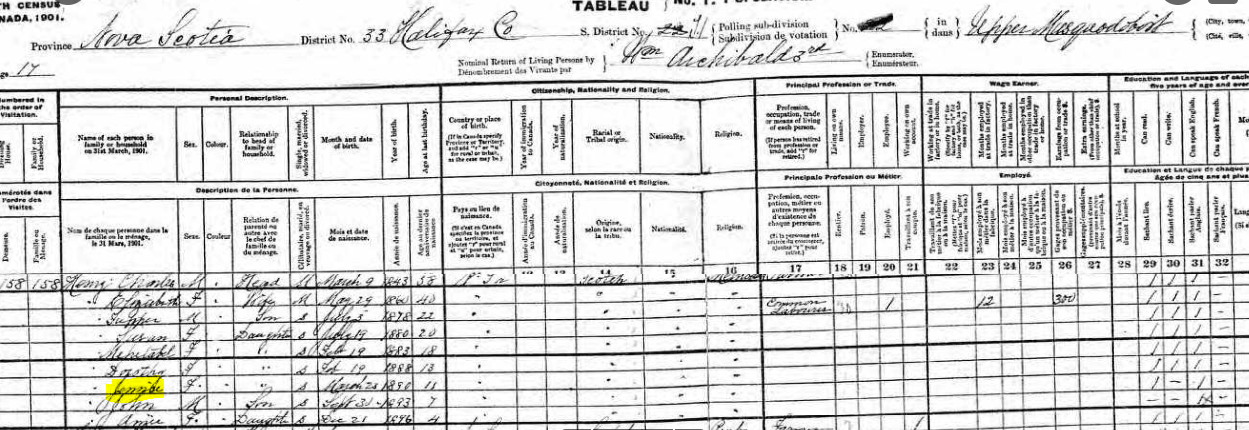
| 1891 Canadian Census - Upper Musquodoboit She is listed as Jannet Henry, siblings Robert, martha, Susan, Tupper, Mehitabel, Dorothy. Jennie is one year old. Parents are Charles and Elizabeth Henry. |
| Google map of location of family in 1891 |
| Satellite view of Upper Musquodoboit, Nova Scotia, Canada |
![]() |
| 1911 Candian Census - Upper Musquodoboit, Halifax County, Nova Scotia Jennie Henry is the daughter of Charles and Elizabeth Henry. Her siblings are, Dorothy, John, Lydia (annie above), and Ada. |
Marriage place was: Weyburn, Saskatchewan, Canada
| Map showing one of the possible routes from Upper Musquodoboit to Weyburn, Saskatchewan. |
| Map view of Upper Musqodoboit to Weyburn to Jim Henry Township |
| View of Jim Henry Township (in dark grey) |
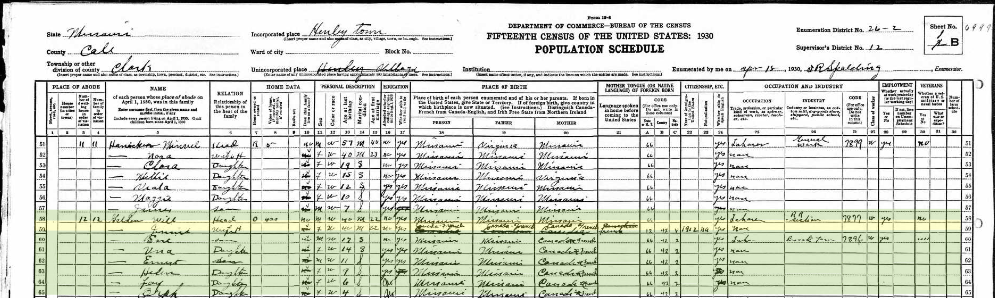
| 1940 United States Census - Schuetz Road, Clayton, St. Louis County, Missouri Wife of head of house, William Golden. Finished the 8th Grade, born in Canada English. In 1935 the family was still living in Miller County, Missouri. |
| View of Schuetz Rd (As it is today) |
So through the years this is what the census records told us about Jennie:
- She was born in Upper Musquodoboit, Halifax County, Nova Scotia March 23, 1890.
- She was of Scottish descent.
- She was probably brought up in the faith of her parents - Presbyterian.
- Her childhood was most likely spent in a rural location - her father was a farmer.
- She completed elementary school into the 8th grade, but had no other formal education.
- Her immigration/naturalization year is 1912 which is the year she married William Golden
- Between 1912 and 1913 they left Canada for Missouri
- She lived in Jim Henry Township / Henley / and finally St. Louis, Missouri
- She did not work outside the home (at least not in 1940).
| Map View of Jennie's census record places throughout her life Upper Musquodoboit to Weyburn, to Jim Henry Township/Henley to Clayton, Missouri |
From 1891 to 1940 Jennie sure traveled a lot of ground! This doesn't even include the times she and Grandpa Golden traveled back Nova Scotia to visit her family.
Friday, February 2, 2018
52 Ancestors in 52 Weeks: Week 2 - Favorite Photo
I really like this prompt of favorite photo, because I have so many! It is really difficult for me to narrow it down to one, so I'm not going to! ;) I'll keep it to a minimum of 5 though lol
![]() |
| Louis Gerling and Veronica Bax on their wedding day. Attendants: Mac Bax and Ann Gerling |
| John Buckley I just discovered this picture this past year and it definitely speaks to a different time |
| Helen Golden James and Larry James <3 <3 <3 |
| Timothy James and Norma Gerling Buckley I just love this photo so much. Grandma looks so happy! |
![]() |
| Norma Gerling Buckley Something about this photo just makes me so happy to look at! |
Thursday, August 21, 2014
Ancestor Spotlight: William S. Golden
I'm really bouncing from limb to limb on my family tree, aren't I? So no questions here, just a run down of some information I have. :) If you have information or questions of your own PLEASE comment or PM me on FB if you don't want to comment here. I completely understand. I am writing these posts in hopes of opening up dialogue and learning more about my family, as well as providing information you may not have known.
Off the soap box and on to the ancestor! ;)
How is he related? My third great grandfather (so for those who are in the same generation as my Dad, this would be your second great)
On April 25, 1906 William Golden passed away, 6 years before his wife Elvira. He is buried in Jenkins-Bungart Cemetery next to her.
Off the soap box and on to the ancestor! ;)
How is he related? My third great grandfather (so for those who are in the same generation as my Dad, this would be your second great)
William S. Golden
(August 17, 1836 - April 25, 1906)
William S. (Maybe Sibbitt) Golden was born August 17, 1836 in Indiana to parents Joseph B Golden and Nancy Sibbitt. The family moved from Indiana to Missouri before 1843. In 1850 the Golden family was living in Miller County, Missouri. Most likely William grew up helping to farm, and on November 1, 1859 he bought 80 acres of land of his own in Miller County, Missouri.
William was first married to Leticia Amanda Ulman on September 20, 1857. This marriage ended in divorce.
A little over a month before William joined the Union in the Civil War, he married Elvira Morgan, daughter of Levi Morgan and Lydia Drum on May 12, 1861 in Miller County. The family had their first child, Nancy Golden, on September 23, 1862.
At the age of 26 William Golden was five feet 8 inches, had a fair complexion with blue eyes and auburn hair.
William spent his time in the military in the following ways:
From June 28, 1861 to October 1861 he was part of the Osage County Regiment Missouri Home Guard. He was a Private. The Osage County Regiment and Hickory County Battalion Home Guard Infantry was organized by authority of Gen. Fremont June and July, 1861. Duty in Camden, Miller, Hickory, Benton and Cole Counties, and at Jefferson City until December. Disbanded December, 1861.
On June 2, 1863 he became a private in Company A of the 6 Missouri State Militia Cavalry. To not overwhelm you with the little details, I wont put all the locations this unit was at. If you would like to know, please let me know and I will post. This, however, was written of this company:
On July 19, 1864 William Golden as part of an organization of veterans of Missouri State Militia Regiments he became part of Company A of the 13th Missouri Cavalry."THE 6TH REGIMENT OF CAVALRY, MISSOURI STATE MILITIA, Headquarters at Springfield, is well mounted and equipped, and armed with Austrian rifles, not at all suited for Cavalry service. The discipline and efficiency of the Regiment is very good, taking into consideration the inferior quality of the arms, and its efficiency would be materially increased if the men were armed with a good breech-loading carbine.
The Regimental and Company books and papers are well and properly kept, and the returns, etc., regularly made out and transmitted in accordance with the Regulations and existing orders."
The following is a detailed report of the regiment's service by Major John E. Mayo from the Missouri Adjutant General Report for Missouri, year ending 1865 (*If you want to skip this, it basically details the service of the regiment. Scroll past it for further info about William S. Golden):
Headquarters 13th Regiment Missouri Cavalry, Volunteers,
Camp Wardwell, C. T. December 10, 1865.
To: Colonel Samuel P. Simpson, Adjutant General of Missouri:
Sir: The regiment now known as the 13th Regiment Missouri Cavalry, Volunteers, existed on the 29th of May, 1864, as a detachment of veterans, reinlisted from the 6th Missouri State Militia, Cavalry, who on that day received at St. Louis, Missouri, their furloughs for thirty days, returning to their rendezvous in St. Louis on the 29th of January, 1864. These men receiver a temporary organization into companies; were officered and equipped for field service. It was not until July 22, 1864, that the organization of the regiment was authorized by orders from Headquarters Department of Missouri, under direction of Colonel E. C. Catherwood, of the 6th Missouri State Militia, Cavalry, but on the day of issue of this order, the detachment was ordered into the field, under command of Colonel Catherwood, to meet an emergency created by guerrilla operations in Caldwell, Ray, Clay, Clinton, and Platte counties, Missouri. During the campaign in these counties, Colonel Catherwood returned to St. Louis to labor in the formation of the regiment, while the detachment, under command of Major Austin A. King, continued in its work of dealing death to ambushed foes. Proceeded to Glasgow, Missouri, to meet in that vicinity the notorious Anderson and his barbarous band; scouting through the counties of Howard, Randolph, Monroe, Callaway, and Chariton, killing in the frequent skirmishes about fifty guerrillas, capturing from the enemy many horses and arms. On the 29th of September, this detachment, with the exception of Captain Mayo and twenty men, who were left at Glasgow, proceeded by boat, with General Fisk, to Jefferson City, and participated in the defense of the capital, against General Price’s last raid into the State. The detachment of twenty men and all the equipments and horses left at Glasgow, fell into the hands of the rebels, by the surrender of the place by General Harding, on the 10th of October, 1864. Captain Mayo (now Major), during the day’s fight, was gallant, repulsing with his detachment about sixty! ! Ray a nd Clay country militiamen, the repeated charges of two rebel regiments, to take a bridge which he was ordered to hold. During these operations along the Missouri River, the ranks of the regiment were being filled in St. Louis by representatives from the various Missouri State Militia regiments, resulting in the following organizations:
Company E, organized August 29th, 1864, A, B, C, D, and F organized September 5, 1864, companies G and H on the 12th, Company I on the 14th , K on the 20th, and L on the 19th of September. These companies, without having a regimental organization, marched on the night of September 26th to meet General Price, then invading the State at the head of the rebel army, and reported to Major General A. J. Smith, at De Soto, Jefferson County, returning under him to St. Louis before the close of the month. Leaving the Meramec bridge October 1st, these companies marched under Colonel Catherwood, arriving in Union on the 5th inst., and spending there days in scouting to the south and west to a distance of forty miles, thence proceeding on the 7th and arriving at Jefferson City on the 10th inst., where they were joined by the detachment under command of Major King; thence, on the 12th inst. to California; on the 13th to Georgetown; on the night of the 13th to Higgins’ farm, and on the 14th to Milkey’s farm. On the 19th of October, at Killpatrick’s Mills, the regiment was assigned to the 2d Brigade of Major General Pleasonton’s cavalry division, and accompanied the same, marching on the 20th, mostly at night, to Lexington; on the 21st to Fire Creek Prarie; on the 22nd to Independence, losing Major W. C. Lefever and two men wounded, and one man killed. At Independence the regiment made a gallant charge upon a division of the enemy, having two guns in position, cut down nearly every man at the battery, capturing the guns and driving the enemy from the ground. In this charge Captain Turner, Lieutenants Ringen and Vanbebber, and seven men were wounded. Marched the same night to Little Santa Fe; thence to the vicinity of Fort Scott, where the enemy had agin formed for battle. On this day the regiment was in the rear, but was brought to the front, reporting only one hundred and fifteen men, the remainder being disabled by the loss of their horses, by exhaustion; with this small force another charge was made upon the ! left of the enemy’s line, using the saber upon the heads of the rebels, who fled in great confusion, closely followed up until the colonel commanding finding himself far in the rear of the enemy’s line and in danger of being flanked, was compelled to fall back. (Portions of the above are extracted from Colonel Catherwood’s official report.) Nine men were wounded in the last engagement.
On the 29th of October the regiment was at Newtonia, where Major Austin A. King assumed command, and returned to Springfield by November 1st, 1864. One hundred and twenty men of the command, the only ones remaining mounted, proceeded under Major King to Cassville, Missouri, Ozark, Linden, and Huntsville, and on the 15th to Rolla, wither the dismounted body had already proceeded on the 9th inst.
Here the close of the year found the main body of the regiment building winter quarters, while several companies were garrisoning outposts within the district. At the beginning of the year 1865, the regiment was stationed at Rolla, Missouri, where it remained building winter quarters, doing outpost and guard duty, scouting, escorting trains, fighting guerrilla bands, and doing much service in resisting lawless depredations, until May 18th. On the 26th of February, the last company M was organized. May 17th, orders were received at regimental headquarters for the regiment to march via Linn Creek and Warrensburg, Missouri, Lawrence, and Fort Riley, Kansas, to Fort Larned, Kansas. In compliance with these orders, the regiment marched on the following day, leaving four companies, F, H, C, and A, still on duty in the district of Rolla, proceeding with much annoyance from storms and scarcity of forage to Fort Riley, where it arrived the 6th of June, and reported at headquarters District of Upper Arkansas, where the following disposition of companies was made: Company L was sent to Republic County, Kansas, and stationed at Salt Marsh; the other seven companies were ordered to report to the commanding officer of the 2d sub-district (Colonel Catherwood), and were assigned to stations as follows: companies B and D to Little Arkansas Crossing, I, K, and M to Cow Creek Station, E and G to Fort Zarat, Kansas, all on the Santa Fe road. Headquarters was established at Council Grove, Kansas. The duties of these companies consisted in escorting mail coaches and trains, and protecting the road against Indian depredations; the duty was severe and constant, and was performed a great portion of the time without forage for the horses, and some times without rations, and until July the men were so destitute of clothing that for several weeks an entire company was excused from duty, owing to the impossibility of their appearing with decency outside the holes they had dug in the banks of the Walnut Creek for their shelter ! from the severe storms and scorching sun of the plains.
Companies A, C, F, and H arrived in the district during the last days of June. C and H were assigned to Fort Zarat, A and F to escort the Butterfield surveying party to Denver, Colorado Territory, from which expedition they returned in September. On June 29th, the regiment suffered the loss of its respected and efficient commander, by the resignation of Colonel E. C. Catherwood, who felt himself mistreated and neglected. Colonel Austin A. King succeeded to the vacancy thus created, on the 10th of July, 1865.
On the last day of July, nine companies stationed in the district were concentrated at Fort Zarat; from thence headquarters of the regiment, with these squadrons, marched under command of Major Mayo, on the 3d and 4th of August to Fort Larned, Colonel King having been ordered to Council Grove to assume command of the 2d sub-district. Upon the arrival of the command at Fort Larned, it was reported to Major General Sanborn, for service in the field in the contemplated expedition against hostile Indian tribes south of the Arkansas River; here they were joined by Company L. The expedition being abandoned, the regiment furnished a detachment of one hundred men, who returned with General Sanborn to the vicinity of the place appointed for an Indian Council, near the confluence of the Arkansas with its little namesake. Colonel King, in pursuance of orders from Sanborn, accompanied by companies B, C, H, and I left Fort Larned August 26th for Fort Riley, to assume command of the 1st sub-district; the companies also left Fort Larned on the 28th for Fort Zarat, under the command of Major Mayo. While Colonel King was at Fort Riley the sub-districts were discontinued, and he received orders to assemble five hundred men of the regiment at Fort Ellsworth, properly equipped, to proceed to Denver, Colorado Territory. The regiment was then equally divided, one half reporting to Major General Elliott, in the district of Kansas, being stationed, A and F at Fort Ellsworth, D and K at Fort Larned, G and M at Fort Lyon, Colorado Territory. Colonel King, with regimental headquarters, and companies B, C, H, and I started from Fort Riley on September 6th, accompanying Brevet Major General Upton, en route for Denver, Colorado Territory. On September 12th companies E and L also started from Fort Zarat, under Major Mayo, marching over trackless prairie to Smoky Hill, to intercept regimental headquarters, which had already preceded them, overtaking the command of the 17th, after marching day and night. This march occupied the ! column u ntil October 2d. The hardships encountered by the troops were of the most discouraging character; as the expedition had been indifferently provided with forage, nearly three-fourths of the march had to be made without the necessary supplies for their horses. Under ordinary circumstances the animals might have subsisted on the extensive meadow lands, but even this was denied, from the fact that the route traversed was almost wholly destitute of grass, resembling a burnt and barren waste, from which even the native buffalo had been driven to search for greener pastures. As a consequence, the number of dismounted men increased every day, while the exhausted beasts were either left to bait the prarie wolf or urged along the rear in the vain hope, excited by glowing reports, of soon reaching a kindlier soil.
The patience of the troops was much tried, also by the poisonous alkali which they were compelled to use during a great portion of the march, and by the lack of wood, of which scarcely any was found between Big Creek, a tributary of the Smokey Hill, and the Pinery, which we struck about sixty miles from Denver. Having arrived at Denver on the 2d of October, the command went into camp, where it remained until October 5th, when the Colonel received orders to send Company I to Fort Garland, where it is now located, companies H and L to Camp Collier, under command of Mayo, and himself to proceed with companies B, C, and E to Camp Wardwell, and there assume command of the post. The necessities of the service brought Company H also to Wardwell. These four companies have for the last two months been actively engaged in protecting the Platte route from Wardwell to eighty miles below, against the frequent assaults by Indians.
Justice to the men serving at the posts demands a statement of the neglect from which they have suffered to such a degree as to task the utmost endurance of human nature. Being located in a bleak desert, accessible at all points to the rough winds in the season of frost and snow, they have up to the present time, been unprovided with quarters of any description, being compelled by the necessities of the climate, to shelter themselves in the low and moist banks of the Platte. Being removed near a hundred miles from the woodlands, no provision has been made up to the present time for fuel, the men being left to battle with the rigors of the season without firs, frequently not even the amount requisite for the preparation of their food. The repeated efforts of Colonel King to correct these evils have this far failed to produce the necessary remedies. It cannot be surprising that the men should be turning longing eyes towards their homes and being anxious to be relieved from a service in which their labors appear to be so little appreciated, and their claims to meet with no attention. I have the honor to be, Colonel, your obedient servant, John E. Mayo, Major Commanding
As read above, William was given a 30 day furlough, in which time Elvira became pregnant with her second child Joseph Golden who was born on March 1, 1866. William may not have seen his son before his time in the cavalry ended on July 19, 1866. No doubt the transition must have been difficult for him, but it also brings up the question of how Elvira Morgan Golden handled the farm/home while he was away and how difficult it may have been.
William continued to farm throughout his life, most likely in or near Jim Henry Township as that is where the family was living in the 1870, 1880, 1890, and 1900 censu , but at some point he owned a mercantile store in Tuscumbia.
William and Elvira had in total 7 children (I have included who they married, and their children's names I could find)"William Golden and Company"---William had a general mercantile store in Tuscumbia. In 1880, William and his wife, Alvira, were living in Jim Henry Township with their 7 children. When he opened his store, I do not know if he remained on his Jim Henry farm or moved into Tuscumbia. - http://www.millercountymuseum.org/newspapers/vindicator.html
- Nancy Golden September 23, 1862-December 16, 1952 married Ben Berendzen about 1886
- Verona Berendzen
- Fred Berendzen
- Lena Berendzen
- Louie Berendzen
- Emil Berendzen
- George Berendzen
- Leo Berendzen
- Josie Berendzen
- Joseph Golden (Great Great Grandfather) March 1, 1866-January 2, 1947 married Mary Elisabeth Stepp daughter of Joseph and Isabell Freeman Stepp on February 10, 1889
- William Golden (Great Grandfather)
- Isabell Golden
- Ida Golden
- Gracey Golden
- Joseph Golden
- Mary E. Golden
- Bertha Golden
- Beulah Golden
- Leonard Golden
- Eliza Jane Golden August 10, 1867-March 22, 1948 married John Kohenskey August 17, 1888.
- John William Kohenskey
- Nettie Kohenskey
- Mary Kohenskey
- Oliver Kohenskey
- George Kohenskey
- Theodosia Kohenskey
- Hattie Kohenskey
- Henry Kohenskey
- Charles Kohenskey
- Elizabeth Beulah Kohenskey
- Dorothy Kohenskey
- Oliver George Golden September 15, 1872 - August 6, 1939 married Iva Rosalee Jenkins daughter of George and Julia Williams Jenkins on Feb 8, 1903 in Miller County, Missouri
- Raney Golden
- Archie Rado Golden
- Julia Opal Golden
- Lawrence William Golden
- Elmer Earl Golden
- George Gail Golden
- Margaret Golden
- Robert Golden August 27, 1873-October 8, 1954 married Arizona Batty on November 28, 1898
- Orville Golden
- Opal Golden
- Harvey Golden
- Dolly Golden
- George William Golden February 4, 1877 - 1965, married Magnolia Ann Williams on May 21, 1899 in Miller County Missouri.
- Maggie Ethel Golden
- William H Golden April 18, 1880-Mary 12, 1919 married Lucy Anna Maylee
- Nellie Golden
- Ruby Lucille Golden
On April 25, 1906 William Golden passed away, 6 years before his wife Elvira. He is buried in Jenkins-Bungart Cemetery next to her.
Subscribe to:
Posts (Atom)