Showing posts with label Immigrant. Show all posts

Wednesday, June 13, 2018

Sophia DeBruijne


Sophia DeBruijne
(Special thanks to Nicole, for the picture!)

Sophia was born on March 1, 1844 in Ijzendijke, the second child and first girl of Cornelius DeBruijne and his wife Eugenia Francisca VerCruijsse DeBruijne.
This document basically states on the first of the month of March of 1844 Cornelis De Bruijne of Ijzendijke appeared before the Burgemeester (the mayor) to declare that a child was born to he and his wife, Eugenia Francisca Vercruijsse a girl who was given the name of Orthensia Sophia. At the time of her birth he was a bricklayer and Eugenia was a woman worker.  Witnesses were Johannes Francies Peeters, 39 years old, a farmer, and Abraham Leenhouts, 38 years old, also a farmer. They were chosen by the declarant.
Someone was kind enough to send me a link to how the last name may have been pronounced: Click to listen Which.. do not ask me to replicate! It translates as "the brown one" which is interesting as Cornelius was fair skinned, had blonde hair, and blue eyes according to his military record. According to one site, it may have also been referring to someone who habitually wore brown clothing, such as a monk or a cleric and nothing to do with the person's complexion.  But for all we know, Cornelius may have taken after his mother's side and not his father's. 

Ijzendijke, the town in which Sophia was born, is a small town in Zeeland, Netherlands, close the border of Belgium.


Sophia probably had very little memories of her time living there, as in 1848 the family chose to emigrate from their home and to the United States.  This may have been due to some different factors. I reached out to a group on facebook called "Dutch Genealogy" and a kind man named Willem helped by giving some insight into what those factors might be.

Belgische opstand (1830-1839) that caused Cornelius to be drafted, gave a lot of economic problems in the 1840s in the southern provinces. People were scared that the provinces would join the Belgian side, which meant that investments in those provinces lessened so created an economic donwnturn.  In 1845 the potato harvest was unsuccessful and life became difficult until around 1849
It is most likely due to this economic downturn that Cornelius and Francisca decided to leave.  According to their emigration reason Cornelius reported "improvement of existence." At the time of their departure, the family had grown to three children. A third son (Francois) had been born. Sophia also had an older brother, Johannes, who later changed the spelling of the DeBruijne name to DeBrine.

On April 22, 1848 the family boarded the Birtish Barque Sarah in Antwerp. The ship itself is described as a carvel-built, square-rigged ship, 536.95 tons, 128 feet long x 25.6 feet broad x 18.9 feet deep, with a woman figure on the stern. A Barque refers to a type of sailing vessel with three or more masts having the fore- and mainmasts rigged square and only the mizzen (the aftmost mast) rigged fore-and-aft. 


Sophia was four. I think they must have had the destination of Missouri in mind although I have yet to figure out who they may have known in the area as they were certainly not of German stock like most of the community that they joined. On the ship there were Germans, Belgians, and, of course, Dutch. Perhaps of these Germans were others traveling to Missouri. Of the 175 people on board, 4 died, all of whom appeared to be very young children.

Also unlike our German ancestors, they did not enter the US through New Orleans, but instead landed in New York on July 3, 1848 after a 72 day voyage.


At the time of the DeBruijne's immigration there was no central processing area, that would not come until 1855 when Castle Clinton was converted into Castle Garden, the country's main immigration center.  Sophia's parents would have instead met a custom collector at the docks.  In 1847 a state commison found that many frauds were being perpretrated against new arrivals and so by 1848 the state had leased a pier at the end of Hubert Street to process and protect immigrants from those who would take advantage of them.

If Cornelius and Francisca's daughter's Maria DeBruijne Kleffner's death certificate is accurate she was born in Westphalia in September of 1848 which means that the family may have traveled straight away to that area of Missouri.  I am unable to find them in the 1850 census.

By 1851 the family was definitely in Westphalia as the youngest child Theresia was baptized on Spetember 23, 1851 at St. Joseph Catholic Church. So in summary the children of Cornelius and Eugenia are as follows:

  1. Johannes Bernardus DeBruijne b 2/26/1843
  2. Sophia Constantia DeBruijne b. 3/1/1844
  3. Francois Bernard DeBruijne b. 11/28/1846
  4. Maria DeBruijne b. 9/11/1848
  5. Theresia DeBruijne b. 8/18/1851
Their children were young enough that they probably picked up quickly on the language and customs around them.  It may have been more difficult for their parents. On December 26, 1852 tragedy struck the family as their mother passed away, leaving 5 young children, all under 10, behind. Seven years later tragedy followed in the death of their father, Cornelius, on February 5, 1859.  Sophia would have been almost 15.  

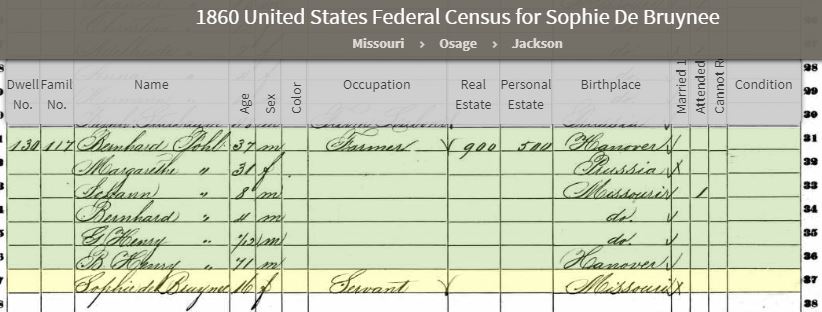
Sadly, all the children were split up among other households.  Sophia was found in the 1860 census as a servant in the home of Bernard Pohl. John, in the home of Christoph Surhoff, Theresia in the home of Liborius Kersting.  I have not been able to find Francois and I am not sure that he did not pass away between the time of their arrival and 1860 also.  I have not been able to trace him at all through any of the censuses, but have with the others. For the 1860 census I was also hardpressed to find Marie.

Between 1860 and 1863 Joseph Bax (the son of Johann Heinrich Bax and Anna Maria Theresia Knaup) met, and on April 7, 1863 they were married.  Sophia was 19 and Joseph was 26. It was his second marriage, his first wife Catherine Boekmann had passed away.  He, too, was an immigrant and was from Ostenland, Paderborn, Germany.  There was probably no language barrier between them, as I stated earlier Sophia was a young child when she immigrated and probably picked up German rather quickly.  


By 1870 the couple had three children:
1. Therese Anna Bax b. 1/28/1865
2. Elizabeth Bax b. 2/9/1867
3. John Bax b. 11/13/1868

By 1880 they had, had 5 more:

4. Henry Bax b. 1871
5. Frank Bax b. 8/10/1873
6. Anna Bax b. 11/30/1875
7. Benjamin Bax b. 1877
8. Peter Bax b. 2/12/1880 


Joseph and Sophia would only have one more child before his death, Sophia born May 30, 1882.  On September 26, 1884 in Jim Henry Township, Joseph was gored by a bull and after laying in a coma for 10 days passed at 6am on October 6. The cause of death was given as coma caused by effusion into the brain, which caused inflammation, and as a  result of extended Phlyonmous ereoypilos (Google has not come up with answers as to what this is supposed to be) of the face 10 days. I imagine this was a traumatic injury and that it was very hard for his wife.  


He was buried on October 7, 1884 at St. Lawrence Catholic Cemetery in St. Elizabeth, Miller county, Missouri. His tombstone states Joseph husband of Sophia Bax.


It is amazing to think of what Sophia must have gone through in the days after.  She had nine children ranging from the age of nineteen to two years old. This is when Grandpa Peter Bax probably went to live with his oldest sister Therese who married John Lueckenotte in 1884. Unfortunately there is no 1890 census so it is difficult to say where the other children went to live, if they didn't live with Sophia. On August 23, 1887 Sophia remarried to William Talken, who was had also been widowed with 2 young children of his own. He was first married to Mary Veltrop who passed away on January 29, 1887.  He had 2 young children of his own: John born September 16, 1878 and Katherine born March of 1884.  


As I said there is no 1890 census so there's no way to know who was back in the household at that time. By 1900 all of her children with Joseph Bax were adults, the youngest Sophia would have been 18 at this point. 


The 1900 census finds Sophia and William living in Osage, Missouri.  It says that Sophia had 11 children, 9 of whom were living. I am unsure of when the 2 children who died, passed, or when they were born.  More research will have to be done in that regard. 


In the 1910 census it says that of her 11 children, 8 were living.  One of her sons, John, had died in the intervening years. 

Another census I wasn't able to find :( was the 1920 census. 

On March 21, 1926 at the age of 82 Sophia died of "chronic interstitial nephritis" of which she had been suffering of for 2 years. 


On April 2, 1926 she was buried at Saint Anthony of Padua Cemetery in Folk, Osage, Missouri. I am not sure why this cemetery was chosen for her as her first husband is buried in St. Elizabeth and her second husband who passed in 1939 is buried in Mary's Home. 


I cant say why, but I feel such a connection with Sophia.  She went through so much in her 82 years and kept going.  There was so much resiliency and strength of character. 

I could only find 3 pictures of her children so far.

Frank M. Bax (1873-1958)
Anna Bax (1875-1939)
Peter Bax (1880-1981)

As for Sophia Constantia DeBruijne's siblings:

John DeBrine married Mary Eiken
Francois (again unsure that he didnt die before I could find him on a census)
Maria married Joseph Kleffner
Theresia (unsure)

As always if you have more to add please let me know! I will add to this as I find more information namely:

Census records: 1850, 1870, 1920
Pictures: Therese, Elizabeth, John, Henry, Benjamin, Sophia
2 other children that Sophia had other than the 9 listed above

Sunday, March 11, 2018

52 Ancestors in 52 Weeks: Week 9 - Where there's a Will

So this prompt could be either an interesting will, someone determined to do something, or a Will in the family.  Well we have lots of Williams on the Golden side!  So lets start with the first one! Did you think it was Grandpa Great? Nope, try 10th Great Grandpa Golden :O Also look at all these William's and Joseph's. Poor Andrew, lol, sticking out like a sore thumb.
Are you tired of scrolling down? Here is some information on William Golden.

The original surname may not have been Golden and may have been Goulder or Golding.

These are all the notes I have gathered on him through various sources:

According to William H. Stillwell's "History of Gravesned" p. 37  William Goulding was born in Ireland about 1613, embarked from London, August 2, 1635, in the George for Virginia and was probably one of George Holmes' party which tried to put a settlement on the Delaware; was captured by the Dutch and brought to New Amstedam.  Campion says a William Golding was a taxpayer in Barbadoes and may ahve been the same person later in Gravesend.  Salter in his History of Monmouth and Ocean Counties says it is supposed that William Golding was one of Lady Deborah Moody's friends who left Massachusetts on a count of Puritan persecution.  Be that as it may, William Goulder or Golding, it seems likely first settled in New Amsterdam sometime prior to his marriage in 1644, as in 1643 he signed a certificate of election.

By deed dated March 20, 1649 (book 1, page 31) William Goulder bought land in Gravesend and presumably moved there about that time from New Amsterdam.  For several years, starting ca. 1666 he was town clerk, signing as "Will Goulding - clarke."  On May 5, 1652 Ann Goulder, wife of William Goulder was defendant in an action of defamation.  She was found guilty and warned.  The warning apparently was not heeded for on Sept 13, 1652 she was again accused.  This time the Court ordred that "Ann shall sitt in ye Irons halfe one hower and after bee taken out and stand in a publicke place with a pap one her breast w her hands bound behinde her..." (ibid. pp. 133,134)

Two deeds, one dated, Jany 12, 1660, and the other Feb 13, 1660 (Book II, pp. 59, 62), for land in Gravesend were signed by Will Goulder alias Goulding.  On March 20, 1665 John Smithe of Gravesend coveyed land known as No. 35 to his father-in-law William Goulder alias Goulding (Ibid. pp 87, 88) and Will Goulding reconveyed his land March 21, 1666/67 (Ibid p. 91) On June 15, 1669, Will Goulding, Clarke, attested to a conveyance which had been witnessed by Joseph Goulding, his marke (ibid, p. 101). This witness was probably the young son about 15 years of age.

William Goulding was one of the twelve men to whom the Monmouth patent was granted in 1665.  In the original division of town lots in Middletown, 1667, he was given Lot 25, and also outlands.  He sold his town lot and meadows to Richard Hartshorne, the deed for which is dated April 23, 1670, and recorded Nov 25, 1672.  In the records of Freehold, NJ, his name is given as Will Golding.  It is not clear when William Goulder died, there being confusion in the records between William, Sr., and William, Jr., but it seems likely that the death occuredn ot too long after 1672.

---
Dutch manuscripts, 1630-64


Maybe about this William Goulder (Golden):

May 3, 1646
Court proceedings. William Goulder vs. Thomas Gridy; defendant to pay 20 guilders, for having suffered three defaults

September 15, 1646
Deed. Govert Lookermans and Direk Cornelissen agents to William Goulder, of a parcel of land at the east river on Manhattans island

February 7, 1647
Huyck Aertsen vs. William Goulder for purchase of a house and plantation, with corn; ordered that plaintiff prove the sale of the house and corn, and that Goulder's wife received the corn; also that he had asked her, when she lost her husband, Smith, whether she held to the bargain, which she took amiss.

April 1, 1653
Deed. William Goulder, attorney of Robert Pennoyer, to Arent van Hattem, bargonmaster; piece of land in Gravesend, L.I. (not executed)

-------------

In regards to deed above ^ on September 15, 1646
New Amsterdam and its people: studies, social and topographical, of the town ... By John H. Innes

 At some time prior to the year 1646 Loockermans associate Cornelis Leendertsen died and Dirck Cornelissen who seems to have been his son had taken his place other partners in the Netherlands are spoken of in some papers executed by Loockermans and Dirck Cornelissen about this time but this may refer merely to others of Cornelis Leendertsen's heirs It was at this period that Govert Loockermans and Dirck Cornelissen after reserving the farmhouse and a parcel of ground of irregular shape lying to the east of it and embracing three acres or more of land disposed of the rest of the farm in the following manner The land lying between the farmhouse and Allerton's warehouse then probably just in course of erection was sold to one William Goulder This parcel which covered nearly two acres of ground ran from the height next the Strand back to Bestevaers Kreupelbosch and its easterly line seems to have about crossed the site of the present Harper building near Franklin Square along its foot on the Strand no longer following the present Pearl Street ran the road to Loockermans farmhouse and to the ferry

....f Loockermans and Cornelissen had any expectations that the neighborhood of their East River farm was to be improved by the grants they made to William Goulder and to George Cleer in 1646 they were doomed to disappointment Neither of these men seems to have made any attempt to build upon the lands purchased by them There are traces of Goulder's occupation of his parcel as late as 1649 after which no further reference to him is met with.
(footnote: He may have been the person called William Goulding, whom we find 1661 in Gravesend, L.I.)

----------------------
Treatise upon the estate and rights of the corporation of the city of New York, as proprietors
, Volume 2

April 10, 1647: Phillip De Truyn to Isaac Ollerton.  Transport, out of the withinmentioned land, unto Isaac Ollerton, a certain parcel thereof, stretching north from the strand to the highway, being in breadth 1 rod and 1/17th and in length, along the waid way to the lot of William Goulder, 46 rods, and so back again from the way to the strand.

------------------

The Journal of the Friends' Historical Society, Volumes 9-10 By Friends' Historical Society, Norman Penney


Regarding William Goulder selling his land to Hasthorne (see above)

Richard Hartshorne was a considerable setler who at Middletown in 1669 It was not until the year of GF s that the governor and council of East New Jersey were to purchase all lands from the Indians and to reimburse themselves from the settlers Meanwhile Richard Hartshorne met with some difficulty as he relates in the following account The Indians came to my house and laid their hands on the and frame of the house and said that house was theirs they had any thing for it and told me if I would not buy the land I must be gone But I minded it not thinking it was land and they wanted to get something of me they at last me they would kill my cattle and burn my hay if I would not the land nor be gone then I went to the Patentees they told me it was never bought nor had the Indians any for it Nicolls the first English governor of New Netherlands desired of them and the Indians also only to have leave to a trading house and at that time they did not intend any should have the land but keep it for the use of the country always giving leave for any man to trade with goods and otherwise but I told them I would not live on those terms and only so but it was dangerous for the Indians threatened to my cattle they told me no man had power to buy but patentees and they would buy it thus it continued months I considered the thing as well as I then was capable and went to Gravesend Long Island and bought Goulder one of the patentees out and when I came back Indians were at me and I did buy them out also in Smith New Jersey p 63 n

---------------
Documents Relative to the Colonial History of the State of New-York: new ser ...
By John Romeyn Brodhead, New York (State). Legislature


May be this William Goulder, or son:

Eight mounted and well armed men came yesterday morning to Jamanica to wit Bartholomeus Appelgaet Charles Morgan Natingh Thomas Witlock James Hubbard William Goulder Goetman Ben and NN who on starting had called out to some New Utrecht people happening to be at Gravesend How is it now Will you be the King's or the States men and then they rode off


-------------------------

Documents of the Senate of the State of New York, Volume 3
By New York (State). Legislature. Senate

Q What book have you in your hand
A It is an abstract that I had prepared of the Sedge Bank division in Coney Island which covers the different grants from the first and second grantees to the people who settled the town of Gravesend
Q Who is the first grantor
A What is called the Dutch East India Company
Q And who is the grantee
A Lady Deborah Moody and her thirty nine associates
 Q When was that
 A The 19th of December 1645
Q That is the first grant
A Yes
 Q Is there a second grant
 A Yes sir by the English governor Francis Lovelace by order of King James
Q What year was that
A The 22d of July 1670
 Q Who was that to
 A Lady Deborah Moody and her thirty nine associates This was a confirmation of the former grant
Q Do the names of the thirty nine associates appear
 A Yes sir It is granted in trust to Lady Deborah Moody and specifies the names of the trustees as follows James Hubbard John Tilton Jr William Goulder Nicholas Stiliwell Josim Guilock Next is a grant by the West India Company which latter company succeeded to the rights of the East India Company This is to give to these people the right to plant colonies in the New Netherlands and is dated Juue 7 1629
Q Does that confirm the grants to this party
A Yes sir This is more a definition of the powers and the privileges given them such as hunting and fishing and states what kinds of clothes they shall wear and what shall be reserved to the West India Company out of the fishing etc This does not go so much to the title of the land as it does to the privileges they are to have I will read one The padroons may if they think proper make use of all the lands rivers and w oods lying contiguous to them for and during so long a time as this company shall not grant them to other padroons or private persons This is privileges to occupy this land bnt not a grant in fee The first grant in fee was made as that paper states to Lady Deborah Moody and her thirty nine associates to Coney Island as a pasture This is a formal grant to anybody who may plant colonies anywhere in the New England States or in New York or anywhere down to the line of Maryland
Q Was that prior to the original grant
A Yes but it was simply rights that they might enjoy if they would come here and live but did not give them any title Then in the second crown where this old Dutch grant was confirmed by the English they give to these thirty nine associates and Lady Deborah Moody Coney Island Instead of saying And all Coney Island for a pasture it says And all Coney Island That gives them the fee title to all of Coney Island The names of the thirty nine are as follows But before giving them I will say there are thirty nine lots here but some of these people owned one and two and sometimes three lots so there are not thirty nine names but there are thirty nine lots Nicholas Stilwell lot No 1 Richard Stilwell lot No 2 Rem Van Cleef lot No 3 Daniel Lake lot No 4 Richard Stilwell lot No 5 Peter Gronendyke lot No 6 John Griggs lot No 7 Nicholas Williamson lot No 8 Samuel Geritsen lot No 9 Richard Stilwell lot No 10 John Griggs lot No 11 Rem Van Cleef lot No 12 Sam l Hubbard lot No 13 Dan l Lake lot No 14 Isaac Denyse lot No 15 John Van Voorhees lot No 16 Richard Stilwell lot No 17 Peter Gronendyke lot No 18 Wilhel minus Ryder lot No 19 Ferdinandus Van Sicklen lot No 20 Wm Johnson lot No 21 Daa l Lake lot No 22 Nicholas Stilwell lot No 23 Cornelins Stryker Albert Terhune and Nicholas Stilwell lot No 24 Bernardus Ryder lot No 25 Benj Steinmetz lot No 26 Jacobus Van Meys lot No 27 Cornelins Emaus lot No 28 John Griggs lot No 29 Richard Stilwell lot No 30 Daniel Lake and F Van Sicklen lot No 31 Bernardus Ryder lot No 32 Albert Terhune lot No 33 Ferdinandus Van Sicklen lot No 34 Cornelins Stryker lot No 35 Nicholas Williamson lot No 36 John Van Voorhees lot No 37 Cornelins Emans lot No 38 Isaac Denyse lot No 39