Saturday, February 3, 2018

52 Ancestors in 52 Weeks: Week 5 - In the Census


I think for this prompt, I'll follow an individual through census records.

I've decided on Jennie Henry, Grandma James's mother. :)


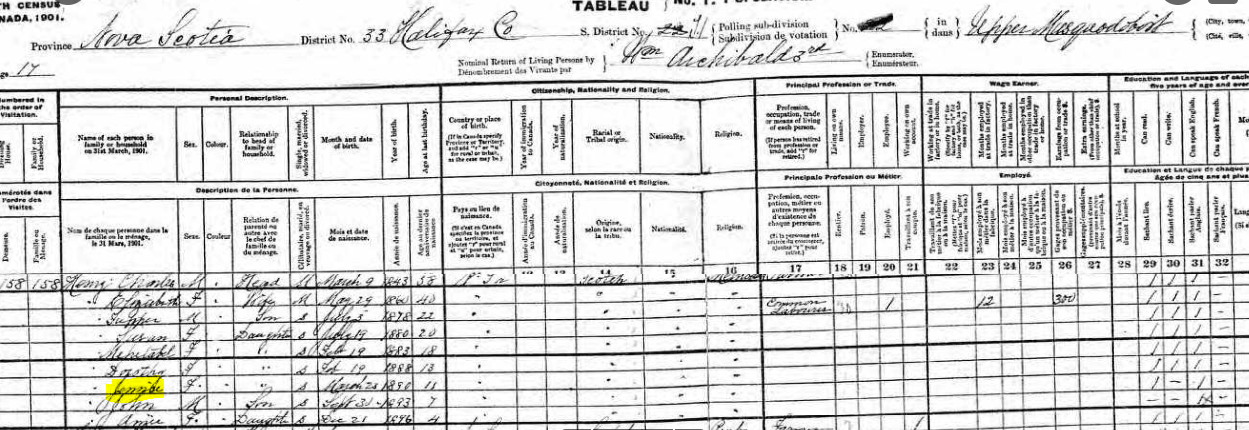
1891 Canadian Census - Upper Musquodoboit
She is listed as Jannet Henry, siblings Robert, martha, Susan, Tupper, Mehitabel, Dorothy. 
Jennie is one year old.  Parents are Charles and Elizabeth Henry.
Google map of location of family in 1891

Satellite view of Upper Musquodoboit, Nova Scotia, Canada

1901 Canadian Census - Upper Musquodoboit, Halifax County, Nova Scotia
Jennie Henry is the daughter of Charles and Elizabeth Henry. 
Her siblings are, Tupper, Susan, Mehitabel, Dorothy, John, and Annie.
Her father was methodist and a farmer.

1911 Candian Census - Upper Musquodoboit, Halifax County, Nova Scotia
Jennie Henry is the daughter of Charles and Elizabeth Henry.
 Her siblings are, Dorothy, John, Lydia (annie above), and Ada.
We know that Jennie and William Golden married in 1912 in Saskatchewan so we know between the years of January 1911 and September 1912 (when they married) she traveled from Upper Musquodoboit to Saskatchewan.

Marriage place was: Weyburn, Saskatchewan, Canada

Map showing one of the possible routes from Upper Musquodoboit to Weyburn, Saskatchewan.
As you can see it was a long journey! I dont know yet why she chose to go there, except to maybe find work? Did she have family there? Does anyone know?

1920 United States Census - Jim Henry Township, Miller County, Missouri
She is listed as the wife of William Golden. Able to read and write. 
Year of immigration was 1912, also naturalized in 1912. 
Mother language was english. No profession.
After their marriage in 1912, William brought his wife Jennie, back to Missouri to live.  They must not have lived in Saskatchewan very long as the birth of their son, Earl, was in Missouri in 1913.

Map view of Upper Musqodoboit to Weyburn to Jim Henry Township

View of Jim Henry Township (in dark grey)

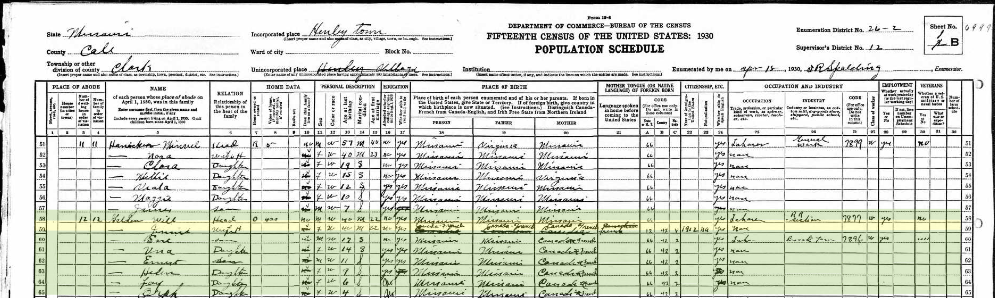
1930 United States Census - Henley, Cole County, Missouri
Listed as wife of Will Golden. She was 22 years old at time of marriage.
 Language spoken in home before coming to USA was French (contradicts 1920 census). 
Naturalized and immigrated in 1912.
1940 United States Census - Schuetz Road, Clayton, St. Louis County, Missouri
Wife of head of house, William Golden. Finished the 8th Grade, born in Canada English.
In 1935 the family was still living in Miller County, Missouri. 

View of Schuetz Rd (As it is today)

So through the years this is what the census records told us about Jennie:

  1. She was born in Upper Musquodoboit, Halifax County, Nova Scotia March 23, 1890.
  2. She was of Scottish descent.
  3. She was probably brought up in the faith of her parents - Presbyterian.
  4. Her childhood was most likely spent in a rural location - her father was a farmer.
  5. She completed elementary school into the 8th grade, but had no other formal education.
  6. Her immigration/naturalization year is 1912 which is the year she married William Golden
  7. Between 1912 and 1913 they left Canada for Missouri
  8. She lived in Jim Henry Township / Henley / and finally St. Louis, Missouri
  9. She did not work outside the home (at least not in 1940).

Map View of Jennie's census record places throughout her life
Upper Musquodoboit to Weyburn, to Jim Henry Township/Henley to Clayton, Missouri

From 1891 to 1940 Jennie sure traveled a lot of ground! This doesn't even include the times she and Grandpa Golden traveled back Nova Scotia to visit her family.

Friday, February 2, 2018

52 Ancestors in 52 Weeks: Week 4 - Invite to Dinner

This one is a little tough, because I have loved ones I would love to see again, but if I had to choose based on solely genealogy questions - it would be that darn Randolph "Randell" James from Tennesse!

Seriously! It's like he just popped out of the earth!

Mushu gets my frustration LOL

But in all honesty, he has been my brick wall for quite a while.   I know he existed, because well, I exist, and some bare bones facts, but cant figure out who his parents were, if he had any siblings, is the other James family in Sevier county at the time related?! 

I have devoted so much time to this man, if he sat down for dinner, first I'd introduce myself. 

I'm your great great great great Granddaughter, and Sir, you have a lot of descendants. And all of us are frustrated with your squirreliness and your decision to put yourself somewhere, where a fire destroyed the courthouse. How am I supposed to locate your documents!?

I'd ask - 

Who is your Father? Your Mother? Where are you from? Are you from Virginia, Tennessee, or from none of those - because your children couldn't seem to agree. Where did you marry your wife? How did you meet?
What is your favorite color? 
Do we share any of the same characteristics? 
Grandpa Randall James send me a breakthrough if you cant answer! 
And I'm sure I'd have so many more questions for him. But I guess I'm stuck trying to find the answers by piecing together all the puzzle pieces of crumbs of information I DO have. :( Bummer.

52 Ancestors in 52 Weeks: Week 3 - Longevity

Longevity...

So we all know that Grandpa Bax lived to be 101, but did you know that Margaretta Adelaide Lammers lived to be just shy of 100 (at least according to the newspapers ;) )

Margaretta Adelheid Lammers Hollenbeck
1831/1837-1930
B. Twist, Germany D. Miller County, Missouri

Margaretta Adelaide Lammers is Louis Gerling's Grandmother
(so my Grandma's Great Grandmother, and my Great Great Grandmother)
According to my research Margaretta was born February 28, 1837 in Twist, Germany, which was at that point in the Kingdom of Hanover, on the boarder of the Netherlands.  

Her birth date is a bit contentious, according to the newspaper article (excerpt provided below) she was born in 1831 if she were 99 in 1930.  More information about that later!

She was the daughter of Johann Heinrich Lammers and Anna Catherine Schweiters. She was the oldest out of her siblings. Her father died when she was very young, in 1844, and her mother remarried to Herman Heinrich Mollers. 

The family emigrated from Germany to the United states in 1852 and on May 28, 1867 she married Herman Heinrich Hollenbeck in Osage County, Missouri.

Herman Heinrich was a widower and had 7 children from 2 previous marriages.

To Margaretta and Herman they had 4 children:

  1. Herman Heinrich Hollenbeck
  2. Catherine Hollenbeck
  3. Sophia  Hollenbeck (who married Herman Joseph Gerling)
  4. Gertrude Josephine Hollenbeck


Through the years she  lived in Crawford Township in Osage County, Boone Township in Maries County, and Jim Henry Township in Miller County, Missouri.

After her husband passed in 1901, she was head of the house of 1910, but then in 1920 she was living with her daughter Sophia and her son-in-law Herman Gerling. 

Published March 10, 1930 Jefferson City, Missouri
Four Generations at Mrs. Hollenbeck's 99th Birthday Party
Mrs. Adelaide Hollenbeck celebrated her 99th birthday at Meta yesterday with four generations present.
Mrs. Hollenbeck has resided in the Meta neighborhood for more than 75 years and is probably one of the best known women in that section of the state.
Despite her advanced age she has retained full possession of all her faculties and enjoyed the party as much as anyone present.
Among the eighty guests present were the following from this city: Mrs Theodore Gerling, a daughter; Mrs. Jerry Goller, a grand daughter, Louis Gerling, a grand son; and Mrs. Mary Price,  a great grand daughter.

I am unsure how the years got mixed up either way.  

In the census records:
1870: 33 years
1880: 45 years
1900: 62 years
1910: 70 years
1920: 86 years

There was no consistency, and it seemed every census year her birth year got pushed back. Maybe she didn't know it?  She was christened on March 1, maybe this was the reason for her birthday being March 7 on her death certificate.  I got my birth information from a website, perhaps it was incorrect. Or perhaps her birth was documented on something she brought with her and the christened date of 3/1/1837 was read as 3/7/1831?  and used for her birthdate?

Either way, according to the newspaper she was 99 ;) as well as her death certificate


And then to confuse the issue even more - there's a different birthdate (March 10, 1831) on the tombstone!


Whether she was 92 or 99 or some age in between, she saw so many changes and experienced during that time. She went from living in Germany on the dutch border to living in the Midwest. At that time there were only 31 states in the Union, with California just joining in the year prior to her arrival.

When she and her family left in 1852, the King of Hanover until 1851 Ernest August, the fifth son of King George the III (You'll remember King George III as Mad King George ;) ) and the uncle of Queen Victoria.

Ernest Augustus circa 1850 (source)
The year before the departure, Ernest Augustus died and the new King was his son, George V.

George V King of Hanover 1851-1866
When the family arrived in the states, Millard Fillmore was the 13th president of the United States.  She was now in a country without King and Queens. 

Millard Fillmore circa 1850s (source)
Think of the events she was privy to. She experienced the world as it fought in the Civil War and World War I. About 6 months before her death, the stock market crashed. 

I included some of the inventions/patents that would take place at the beginning of her life, and those at the end. You can certainly google what happened in between, it was just way too much to put on here. But for example in 1830 the Lawn Mower was patented in England, and 100 years later, in 1930 the Jet engine was patented.

Fom 1830-1840 in the first 10 years of her life:
1830Lawn MowerEnglandby Edwin Budding
1830Sewing MachineFranceby Barthelemy Thimonnier
1831Electric DynamoEnglandby Michael Faraday
1833Electric TelegraphGermanyby Gauss and Weber
1834RefrigerationEnglandby Jacob Perkins from the USA
1835Mechanical CalculatorEnglandby Charles Babbage
1835PropellerEnglandby Francis Pettit Smith
1835RevolverUSAby Samual Colt - first multi-shot hand gun
1837Morse CodeUSAby Samuel Morse - for the telegraph
1839Fuel CellEnglandby William Robert Grove
1839VulcanisationUSAby Charles Goodyear - for rubber
1840Postage StampEnglandby Rowland Hill

From 1920-1930 in the last 10 years of her life:
1920Hair DryerGermany
1920Sticky PlastersUSAby Earle Dickson
1923Hearing AidEngland
1923TelevisionScotlandby John Logie Baird
1923UltracentrifugeSwedenby The Suedberg - separates proteins
1924Frozen FoodUSAby Clarence Birdseye
1926Aerosol SpraysNorwayby Erik Rotheim
1926Liquid Fuel RocketUSAby Robert Goddard
1926Popup ToasterUSA
1927Colour TelevisionScotlandby John Logie Baird
1927Quartz TimekeepingSwitzerlandby Hans Wilsdorf from England
1927Talking PicturesUSA
1927VideophoneUSA
1928AntibioticsEnglandby Alexander Fleming
1928Iron LungUSAby Philip Drinker
1930Jet EngineEnglandby Frank Whittle
1930Sticky TapeUSA

If I learn more about her life, I will add it. If you have information about her please feel free to comment! 


52 Ancestors in 52 Weeks: Week 2 - Favorite Photo

I really like this prompt of favorite photo, because I have so many! It is really difficult for me to narrow it down to one, so I'm not going to! ;)  I'll keep it to a minimum of 5 though lol

Louis Gerling and Veronica Bax on their wedding day.
Attendants: Mac Bax and Ann Gerling
John Buckley
I just discovered this picture this past year and it definitely speaks to a different time

Helen Golden James and Larry James
<3 <3 <3

Timothy James and Norma Gerling Buckley
I just love this photo so much. Grandma looks so happy!
Norma Gerling Buckley
Something about this photo just makes me so happy to look at!

52 Ancestors in 52 Weeks: Week 1 - Start

Week 1 Prompt: Start

I started the 52 ancestors in 52 weeks challenge. Obviously I'm behind.. ;) Woops. I am working catching up though!

The Week 1 prompt is "Start"

My answer is the Gerling Start to America. 

Just as a disclaimer: While I tried to do my research as thoroughly as possible, I can't promise that everything is correct. A lot of this is conjecture since we don't know for sure certain things about their immigration experience. I did, however, try my best :) If you have any corrections or information to add, please let me know! This post may be updated as I learn or find more information.

With that being said -  my subject is Gerhard Antonius Gerling. Here is how we are related from Louis Gerling upward:


Gerhard Antonius Gerling was born December 28, 1792 to Wilhelm Gerling and Elisabeth Meyers in Osterath, Germany (which was at that time considered Prussia). Osterath is in Western Germany, further north (See map below). 

Map of Present Day Germany (From google maps):
Maps of Germany aka Prussia prior to and after 1834. (Source)

He was baptized in the Catholic faith on December 30, 1792. Most likely this was done at St. Nikolaus Catholic Church, as through my limited research seems to be the only Catholic church in Osterath. I have yet to find who his Godparents were. 

The church dates from the 11th century with Romanesque arches from that time. It was enlarged in 1538. In 1642, during the Thirty Years' War, Hessian troops burned the church which was restored in 1660. The three-nave Gothic brick church was built in 1855, behind the older tower. The nave is to the west of the tower, not east, because of space. Source
He married first: Anna Christina Wilms on October 23, 1821 and had the following children
1. Wilhelm Gerling b 1822
2. Heinrich Gerling b 1824
3. Catherina Gerling b 1830

Anna Christina passed away on June 19, 1833 and with 3 young children in the home, Gerhard remarried in October of that year on the 22nd to Maria Christina Kronen, the daughter of Herman Adam Kronen and Anna Gertrud Ivangs. She, too, was born in Osterath on February 19, 1800.

They had:
4. Joseph Herman Gerling b. 1834
5. Ludwig Gerling (our ancestor) b. 1836
6. Michael Gerling b. 1839

Between the years of 1820 to 1871 many Germans immigrated due to either hardships of economy such as unemployment and crop failures or to avoid wars and military service. 

Gerhard was a farmer, according to the passenger list, on another site, it stated he was a 'zimmerman' which, I think, is likened to being a carpenter. It may have been that he didn't own his own land, and merely worked as a farmer for someone else. Or perhaps the farm didn't yield enough to get by.  If this were the case, he may not have owned much more than the clothes on his back and a few farm animals (source).  The reason for immigration in the Gerling's case was probably due to the potential promise of their own land to farm in America with the promise of a higher yield in profit and livability. 

But why Missouri? 

It may have been due to the books that were circulating Germany stating that Missouri was a good place to live.  For example Gottfried Duden, a Prussian lawyer who visited and purchased land 50 miles west of St. Louis, wrote a book entitled "Report on a Journey to the Western States of North America" which was published in 1829 and encouraged immigration by his fellow countryman to Missouri.
"How often I have thought of the poor people of Germany. What abundance and success would the industry of a few hands bring to whole families, whose condition in their own country an American-born farmer cannot imagine to be possible. There is still room for millions of fine farms along the Missouri River, not to mention the other rivers.

The great fertility of the soil, its immense area, the mild climate, the splendid river connections, the completely unhindered communication in an area of several thousand miles, the perfect safety of person and property, together with very low taxes - all these must be considered as the real foundations for the fortunate situation of Americans.

In what other country is all this combined?

If one wanted to paint the picture more colorfully, it would suffice to call to mind the rich forests, the abundance of bituminous coal, salt, iron, lead, copper, saltpeter, and other minerals; the active interest of almost all inhabitants in cheerful industry, the utilization of the advantages of their location, and the thriving steamboat services that have already resulted from it; finally, the contrast to all European prejudice with regard to the rank in society of the tradesman and the respect in which physical activity is held...

Many times I have said to myself and to my traveling companion (whom I shall leave behind in the most fortunate situation): People in Europe will not and cannot believe how easy and how pleasant it can be to live in this country. It sounds too strange, too fabulous. Believing in similar places on this earth has too long been consigned to the fairy-tale world. The inhabitants of the Mississippi area, on the other hand, consider the reports of need in Europe exaggerated. The citizens of the state of Missouri, together with their slaves, doubt so much that there are so many white people in Europe who with the greatest exertion can enjoy scarcely as much meat in an entire year as is here thrown to the dogs in a few weeks. They cannot believe that some families would even starve or freeze to death in winter without the charity of others; they are accustomed to attribute such statements to the intention and desire to praise and flatter America. However, sometimes one hears a person say: "Yes, yes, my grandfather told us that life was very hard there." source

His was not the only book to be published expounding upon the advantages of German immigration to Missouri. 

It may have also been due to any family members, or friends with family members, who had written back home about the promises that their new homeland granted them.  Whatever the reason the planning began months in advance.

In order to immigrate they would have had to request and be granted permission to emigrate.  The following would have to occur according to this site: 
  • a statement from the tax collector had to be obtained, which indicated that all the taxes were paid
  •  secondly, a statement from the military commander was necessary, which showed his military status. 
  • With these documents he appeared before the Landrath (district judge) and petitioned for a pass, which, after much delay, was granted to him provided everything was satisfactory. 
Oftentimes it was not just one family from the area that immigrated, it was a group of them.  According to a post about another Osterath immigrant, there were 31 within the group that immigrated to America with the Gerlings. (Source) This would certainly be a source of comfort, to have so many neighbors to bolster their confidence and soothe their homesickness. 

The Gerlings and those traveling alongside them received their consents to immigrate on August 8, 1840 (Remeil).

I can't imagine the courage it would take to pack your belongings and leave your homeland behind and know it was not in your means to visit it once you have left.  That even though others had been successful, you are hoping that you, too, will be met with success because you have a family to support.

In mid-september of 1840 they set off for Le Havre, France, their chosen part of departure.  

It was not only the voyage to America that the Gerlings and their neighbors would have to contend with, but the travel to Le Havre. I am unsure as to why they chose this port as there were certainly some some closer.   It may have been due to the fact that it was common for ships from Le Havre to travel to New Orleans which would provide easier access to Missouri, than landing in New York and traveling across land. 

As you can see below, in today's terms it would be a 112 hour walk to the port. Most likely they had wagons and such to help them transport their goods, but even so it would be a long trek of roughly 325 miles.  

Perhaps they did not walk, but instead boarded another smaller vessel on the coast closer to them that would take them to their departure port.  It is suggested in Robert Rameil's book "Auswandererbriefe aus Minnesota, Missouri, Nebraska und Pensylvania/Emigrant Letters from Minnesota, Missouri, Nebraska and Pensylvania" that they took their wagons to Uerdingen, Germany where they then took a boat on the Rhine River to Rotterdam, Netherlands, where they would then sail to Le Havre.  


By Walk:

By wagon to Uerdingen, up the river Rhine to Rotterdam, to Le Havre.

Below are prints I found of what Le Havre may have looked like in 1840 when the Gerlings arrived to board their ship to America:
Le Havre, France 1840 (source)


Joseph Morlent, Album du voyage au Havre et aux environs (1841) (source

Upon reaching Le Havre it wasn't guaranteed that they would board the ship right away, they may have waited on the docks for a while. 


I found a very good post that describes the port of Le Havre, here, and below is an excerpt from it.

"The accommodation of emigrants awaiting departure is a serious problem.  The less fortunate sleep in the street, on the floor, or up makeshift tents on the banks of the streets and sidewalks of St. Francis and Notre Dame. Others took refuge in shacks close to the fortifications or in the plain with their baggage.  In 1840, the "Revue du Havre" wrote that "the city is crowded with the poorest Bavarian immigrants...  The floating population began to camp out on the ramparts of the east. They takes shelter under the elms; excavations in the thickness of slope ditches serve as their home ... Those who have two francs a day, can find accommodation among innkeepers of St. Francis and Our Lady, who specialize in taking care of immigrants. 
Regardless of what accommodation they may have had beforehand, eventually the family boarded the Edmund Perkins. Below Gerard, Heinrich, Herman, Ludwig, and Michael are listed on the passenger list. I am not sure why it does not also list his wife Maria Christina or his son Wilhelm (Catherina passed away prior to their immigration, in 1834). Could it be that they immigrated at a different time? Or that this list, which is an excerpt, is not complete? It is known that they did immigrate.


I couldn't find much on the ship itself, except that it may have been built in 1838 in Biddeford, Maine, and was referenced in Merchant Sail.  Due to this I think it was a packet ship, meaning that it carried mail, cargo, immigrants, etc.  In 1839, at least, it moved 2019 bales of cotton from New Orleans to Liverpool (source).  It was most likely not steam powered, although these ships existed at this time, the first regular steamship crossings didn't begin until the 1840's and even then well into the 1850's poorer immigrants typically took sailing ships across.

Below is an example of a packet ship. I could not find a picture/drawing/etching of the Edmund Perkins, so this will have to suffice to give us some idea.

Built in 1840 The Shenandoah Capacity: about 290 passengers
(Source)
This is an example of an 1854 packet ship showing cargo below, 


"This cutaway reveals how travelers, immigrants, and cargo sailed together. Travelers with enough money purchased “cabin passage” and slept in private or semiprivate rooms. The vast majority of passengers, usually immigrants, bought bunks in steerage, also called the ’tween deck for its position between the cabins and the hold." - Source

These ships would deliver goods to the continent of Europe and then have space left over when returning back to the states with other trade goods. They would then fill that space up with immigrants.  

It is most likely that the Gerlings were in steerage (If I find that they were able to procure a cabin of some sort on board I will update this later.) In the event that they were steerage this might be what they would have endured if they could not have purchased a first or second class ticket.


Steerage on an emigration ship - 1847 wood engraving (Source)

  • A voyage of at least 6 weeks, maybe longer if weather was unfavorable. However, as they left in mid september from Osterath, made their way to Le Havre, and then landed November 7, 1840 the voyage must have been one of the shorter ones. 
  • The passage itself was not easy, and was often damp, dark, boring, not to mention foul smelling from lack of sanitation. 
  • Sickness and possibly death due to such close quarters.
  • Lack of privacy - As you can see above, living spaces could be cramped and people often slept and ate in the same areas, and with that many people and personalities there were probably some interesting times on board. 
  • Boredom from the long weeks spent on board.
  • Anxiety about the future once they arrived in America.
  • Hope and planning for that same future.
On November 7, 1840 they reached the port of New Orleans. 


New Orleans
1841 color engraving

The historical average for weather on this date in New Orleans is a high of 76 and a low of 57 degrees.  Would this have been a shock to the Gerlings since the average temperature for Osterath is 43.7 degrees for the month of November?  In fact according to this site, the warmest it gets year round there is about 75 degrees and the coldest is 32.36. Comparing that to Missouri weather which can be an average of 88 degrees (and as we know, can be much higher!) and an average low of 24 (which can be much colder!) must have been an adjustment.


Whatever the weather may have been when the Gerlings landed in New Orleans, their journey was not over.   Most likely the family chose to board a riverboat to take them up the Mississippi river where they would land in St. Louis and then travel westward. 


"New-Orleans (Louisiana)". View of the Mississippi River front of New Orleans in the late 1840s by Henry Lewis (source)
In 1840 there were 400 steamboats traveling the Mississippi and New Orleans was the world's fourth busiest port (source). Among the hustle and bustle of so much commerce going on and other ships disembarking, and locating someone who spoke German, not to mention being exhausted from the voyage across the ocean itself,  I assume it was somewhat chaotic and stressful. 

But Gerhard had come with others, and had his family depending on him. I'm sure the small community from Osterath handled it in stride. If anyone had relatives in the group that immigrated before them, the may have been given some idea of what to expect or what to do from letters home.

I am going to end this post here as the Gerhard and family have now arrived in America. :)

If you have anything to add or corrections please feel free to let me know! As stated above, this is a lot of conjecture and guesstimation.